Whole House Fan Installation Cost in 2026: What You Will Pay
Whole house fan installation costs $1,700 on average in 2026, typically $900 to $2,400 installed. Decode the attic-fan naming trap, the CFM sizing rule that drives quotes, and why missing attic vents add $300 to $650.
Planning figures, not contractor quotes. How we calculate
Short answer
Whole house fan installation costs $1,700 on national average in 2026 (Angi, Fixr, HomeAdvisor), with most standard installs landing between $900 and $2,400. A whole-house fan cools the living space by pulling cool outdoor air through open windows and exhausting heat through attic vents; an attic fan ($370-$910 installed) only ventilates the attic itself. Quote gaps mostly come from mount type, CFM sizing, and the $300-$650 vent addition many homes need.
Cost summary
Estimates per project. See the cited sources and methodology before using these figures for a decision.
| Cost level | Estimate |
|---|---|
| Low | $900.00 |
| Typical | $1,700.00 |
| High | $2,400.00 |
Calculate your planning range
Enter rates from your own quotes or research. We do not supply unverified local prices.
How Much Does a Whole House Fan Cost to Install?
A whole house fan costs $1,700 on national average to install in 2026, with most homeowners paying between $900 and $2,400 for a standard unit with professional installation (Angi, Sep 2026; Fixr, Jan 2026; HomeAdvisor). That three-source convergence on the exact same average is unusual and is what makes this band trustworthy. Fixr extends the top of the band to $2,600, and the independent calculator Homewyse (Sep 2026) lands at $1,074 to $1,948 per fan, which sits comfortably inside the same range.
The budget end of the market is a basic model installed by a handyperson at about $800 (HomeAdvisor). The premium end is a variable-speed smart system reaching $3,600 (Angi, HomeAdvisor), and the market-leading manufacturer QuietCool packages its Classic series starting at $1,449 including installation. Running costs are the real attraction: a whole-house fan uses 120-600 watts, costing $0.16 to $0.88 per day for night-only use, against $4.19 to $20.96 per day for central AC (Fixr).
The $1,700 average covers the unit plus installation labor, which runs $300 to $1,000 total at $50 to $100 per hour for 6 to 10 hours of work (Angi, Fixr, HomeAdvisor). It does not cover the two most common add-ons: extra roof or attic vents when the attic cannot exhaust the fan's airflow ($300 to $650), and new electrical work when the attic has no usable circuit.
Sources: Angi: Whole-House Fan Cost 2026 (Angi, Sep 2026), Fixr: Cost to Install a Whole House Fan in 2026 (Fixr, Jan 2026), HomeAdvisor: How Much Do Whole-House Fans Cost? 2025 Data (HomeAdvisor), Homewyse: Cost to Install Whole House Fan, Sep 2026 (Homewyse calculator)
Whole-House Fan vs Attic Fan: Which Are You Pricing?
The first thing to settle is which product is actually on the quote, because the names get confused constantly. The manufacturer QuietCool explains the history: whole-house fans became popular in the 1960s, especially in the South, and people started calling them 'attic fans' simply because the unit sits in the attic. That confusion persists in contractor quotes today, and it matters for the budget: a whole-house fan installed costs $900 to $2,400 (Angi, HomeAdvisor) or $900 to $2,600 (Fixr), while an attic fan costs $370 to $910 (Angi), $225 to $850 (Fixr), or about $600 for a solar model (Fixr).
They do different jobs. A whole-house fan cools the living space itself: it pulls cool outdoor air through open windows and exhausts the home's heat through attic vents (Angi, Fixr, QuietCool). An attic fan only ventilates the attic, keeping it within about 10F of the outdoor temperature so less heat radiates down into the living space (QuietCool, Fixr). The attic fan draws about 300 watts (Fixr) and, per QuietCool, can save up to 30% on A/C cooling costs on its own, but it never replaces a cooling solution for the living space (Angi, Fixr).
So do not compare a $500 attic-fan quote against a $2,000 whole-house-fan quote and conclude the second contractor is overcharging. The two jobs differ by a factor of four in cost and solve different problems. If your goal is to stop running the air conditioner on mild evenings, the whole-house fan is the product. If the attic superheats and shortens shingle life, an attic fan (often paired with a whole-house fan) is the fix.
Sources: QuietCool Systems: Advanced Whole House Fans (QuietCool Systems, manufacturer), Angi: Whole-House Fan Cost 2026 (Angi, Sep 2026), Fixr: Cost to Install a Whole House Fan in 2026 (Fixr, Jan 2026), HomeAdvisor: How Much Do Whole-House Fans Cost? 2025 Data (HomeAdvisor)
Sizing and Venting: The CFM Rule That Explains Quote Gaps
Whole-house fans are sized in CFM, cubic feet per minute of airflow, and every pro source publishes the same family of rules. The DOE (via Fixr) says to size to at least half your home's cubic feet in CFM: square footage times ceiling height, times 0.5. The PNNL Building America Solution Center cites field studies supporting 12 to 23 air changes per hour, which works out to roughly 1.5 to 3 CFM per square foot with 8-foot ceilings. QuietCool refines it by climate: 2 to 3 CFM per square foot of living space, with coastal and mountain homes at 2, inland homes at 2.5, and desert homes at 3.
Take a 2,000 square foot home with 8-foot ceilings: 16,000 cubic feet, so the DOE minimum is 8,000 CFM. Fixr's installed table prices a 2,000 square foot / 8,000 CFM install at $800 to $2,400, right in the national band. Its table spans 1,000 square feet / 4,000 CFM ($600-$2,200) to 3,000 square feet / 12,000 CFM ($1,000-$2,600), so each extra 1,000 square feet adds roughly $100 at both ends.
The line item that blindsides homeowners is venting, not the fan. The attic must have enough net free vent area to exhaust the fan's CFM, and the industry rule of thumb is 1 square foot of net free area per 750 CFM. When the attic falls short, the installer adds roof vents at $300 to $650 (Angi, Fixr), and that is the single most common surprise on the invoice. A quote that looks $400 cheaper than a competitor often just skipped the vent math. Roof vent work often lands with the roofer; our roof repair cost guide has the 2026 numbers.
Sources: QuietCool Systems: Advanced Whole House Fans (QuietCool Systems, manufacturer), Angi: Whole-House Fan Cost 2026 (Angi, Sep 2026), Fixr: Cost to Install a Whole House Fan in 2026 (Fixr, Jan 2026)
Direct-Mounted vs Ducted vs Roof-Mounted: The Real Price Ladder
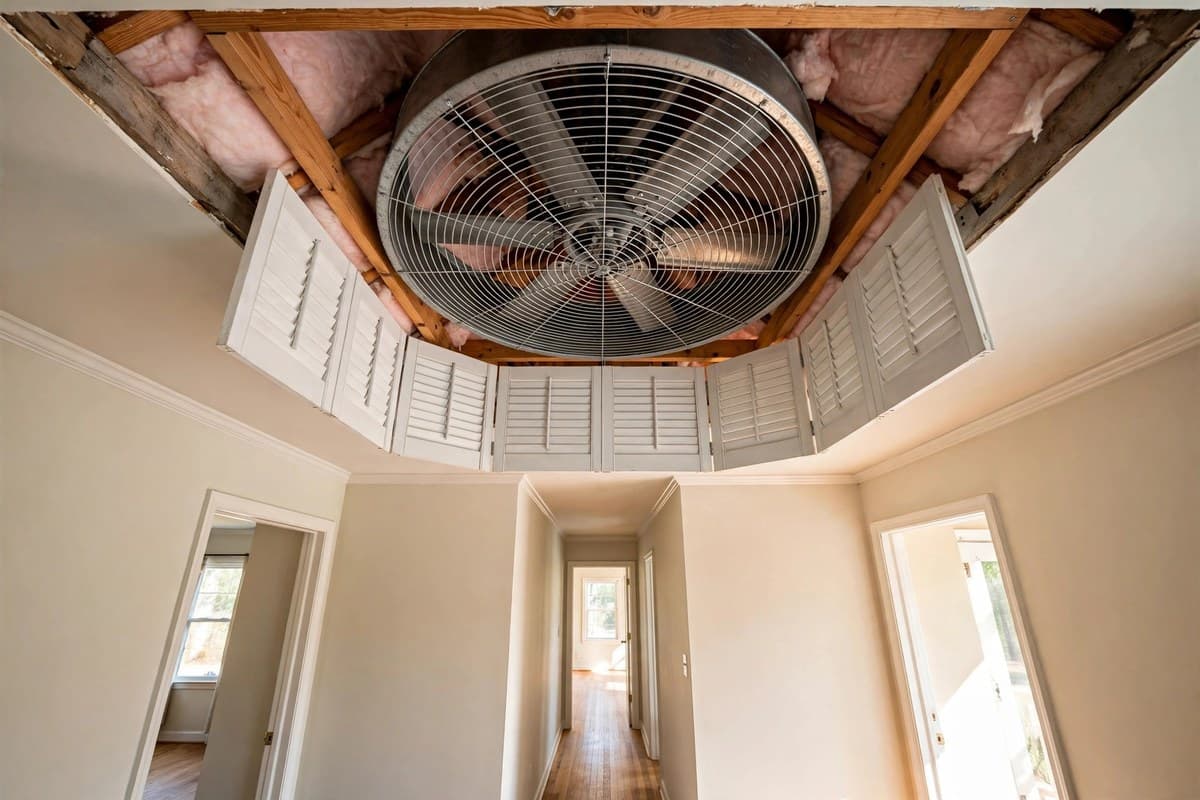
Mount type is the biggest structural price lever, and Fixr's numbers decode the whole band. A direct-mounted fan ($1,400 to $2,000 installed) is the standard retrofit: the unit goes between ceiling joists, usually in a hallway ceiling. A ducted fan ($1,800 to $2,400 installed) is the retrofit option when cutting into the ceiling framing is impractical; the ductwork alone adds $300 to $1,200. A roof-mounted fan ($1,800 to $2,400 installed) costs the most to install and carries the highest leak risk, reserved for flat roofs or homes without usable attic vents. Knowing which mount your home needs tells you which end of the band your quote should land in.
Motor and control choices stack on top of the mount. A direct-drive motor runs $350 to $900 as a unit: cheaper and simpler, but louder. A belt-drive motor runs $500 to $1,200: quieter, but with more maintenance (Angi, Fixr). Fan diameter maps to CFM in Fixr's table: 20-inch (about 4,000 CFM) installs for $600 to $2,200, 30-inch (about 6,000 CFM) for $700 to $2,300, and 36-inch (about 7,000 CFM) for $750 to $2,550.
Speed control is where the premium tier lives. Single-speed units are the budget end; multi-speed and variable-speed units with smart controls climb toward the $3,600 high end (Angi, HomeAdvisor). QuietCool's installed band of $500 to $3,000 across its lineup, with Classic systems starting at $1,449 installed, shows how size, motor, and controls spread the quotes.
Sources: Fixr: Cost to Install a Whole House Fan in 2026 (Fixr, Jan 2026), Angi: Whole-House Fan Cost 2026 (Angi, Sep 2026), HomeAdvisor: How Much Do Whole-House Fans Cost? 2025 Data (HomeAdvisor), QuietCool Systems: Advanced Whole House Fans (QuietCool Systems, manufacturer)
What Drives Installation Cost Up, and Should You DIY?
Electrical work is the first cost driver. Homewyse's basic install scope includes a dedicated 120V 15A circuit and a wall switch; when the attic has no usable circuit, an electrician runs $50 to $130 per hour for 1 to 2 hours of hardwiring (Fixr). Electrical permits run $10 to $500 depending on the municipality, typically around $50 for this kind of work (Angi, HomeAdvisor). A thermostat add-on is $115 to $265 (HomeAdvisor).
Structural and finish work comes next. Cutting ceiling joists to fit a direct-mount unit can require a carpenter at $50 to $100 per hour (Angi). Drywall repair and finishing runs $60 to $90 per panel (Angi, HomeAdvisor), or $300 to $900 for full cut-in build-back with minor patches under $100 (Fixr). Brand tier matters too: budget brands like Master Flow and Air Vent against premium names like Solatube and Centric Air (HomeAdvisor). And climate fit matters for the value case: these fans shine in dry climates where nights cool down, and make little sense in very hot, humid regions where the AC stays on regardless (Angi, HomeAdvisor, QuietCool).
On the DIY question, the math is simple: installing it yourself saves the $300 to $1,000 labor portion (Fixr). But hire a pro when new circuit or switch wiring is needed (Fixr warns that DIY electrical work is illegal in many areas), when ceiling joists must be cut, for roof-mounted units (highest leak risk, per Fixr), or when attic access is limited. DIY is realistic only when replacing an existing unit in an unfinished attic with the wiring already in place (Fixr). Every pro source converges on one rule: hire licensed professionals for the electrical work (Angi, HomeAdvisor, Thumbtack, Fixr).
Sources: Fixr: Cost to Install a Whole House Fan in 2026 (Fixr, Jan 2026), Angi: Whole-House Fan Cost 2026 (Angi, Sep 2026), HomeAdvisor: How Much Do Whole-House Fans Cost? 2025 Data (HomeAdvisor), Homewyse: Cost to Install Whole House Fan, Sep 2026 (Homewyse calculator), Thumbtack: 2026 Fan Installation Cost (Thumbtack, Jul 2026)
Whole House Fan Installation Cost FAQs
What does a whole house fan cost to install in 2026? $1,700 on national average, with most installs landing between $900 and $2,400 (Angi, Sep 2026; Fixr, Jan 2026; HomeAdvisor). The budget end is about $800 for a basic model installed by a handyperson (HomeAdvisor); the premium end is about $3,600 for a variable-speed smart system (Angi, HomeAdvisor).
What is the difference between a whole-house fan and an attic fan? A whole-house fan cools the living space by pulling cool outdoor air through open windows and exhausting heat through attic vents; an attic fan only ventilates the attic. Installed cost is $900 to $2,400 for a whole-house fan against $370 to $910 for an attic fan (Angi), so make sure the quote is for the product you actually want.
What size whole-house fan do I need? Size in CFM: the DOE minimum is half your home's cubic feet in CFM (square footage times ceiling height, times 0.5), PNNL field studies support 12 to 23 air changes per hour (roughly 1.5 to 3 CFM per square foot with 8-foot ceilings), and QuietCool recommends 2 to 3 CFM per square foot depending on climate. A 2,000 square foot home with 8-foot ceilings needs at least 8,000 CFM.
Can a whole-house fan replace my air conditioner? In dry climates where nights cool down, it can reduce or even eliminate AC use (Angi, HomeAdvisor, QuietCool). In very hot, humid climates it cannot dehumidify or cool below the outdoor temperature, so the AC stays required (Angi, HomeAdvisor, QuietCool). Compare QuietCool's installed band of $500 to $3,000 against central AC at $3,900 to $7,900 installed (Angi). For the full central AC picture, see our central AC installation cost guide.
Will it save money on energy bills? A whole-house fan uses up to 90% less energy than compressor-based AC (PG&E, via QuietCool) and costs $0.16 to $0.88 per day for night-only use against $4.19 to $20.96 per day for central AC (Fixr). Angi puts the payback at 1 to 3 years when properly installed, and HomeAdvisor reports a 10 to 20 year lifespan with 5 to 15 year warranties.
Is it safe to run a whole-house fan with a gas furnace? Only with windows open. The fan creates negative pressure that can backdraft furnaces, water heaters, and gas dryers, pulling carbon monoxide indoors (Thumbtack, QuietCool). Open 3 to 4 windows 2 to 3 inches wide on the shaded side before turning the fan on (QuietCool), and never run it at midday heat (QuietCool).
Sources: Angi: Whole-House Fan Cost 2026 (Angi, Sep 2026), Fixr: Cost to Install a Whole House Fan in 2026 (Fixr, Jan 2026), HomeAdvisor: How Much Do Whole-House Fans Cost? 2025 Data (HomeAdvisor), Thumbtack: 2026 Fan Installation Cost (Thumbtack, Jul 2026), QuietCool Systems: Advanced Whole House Fans (QuietCool Systems, manufacturer)
Sources
- Angi: Whole-House Fan Cost 2026 (Angi, Sep 2026) (accessed 2026-10-14)
- Thumbtack: 2026 Fan Installation Cost (Thumbtack, Jul 2026) (accessed 2026-10-14)
- HomeAdvisor: How Much Do Whole-House Fans Cost? 2025 Data (HomeAdvisor) (accessed 2026-10-14)
- Homewyse: Cost to Install Whole House Fan, Sep 2026 (Homewyse calculator) (accessed 2026-10-14)
- Fixr: Cost to Install a Whole House Fan in 2026 (Fixr, Jan 2026) (accessed 2026-10-14)
- QuietCool Systems: Advanced Whole House Fans (QuietCool Systems, manufacturer) (accessed 2026-10-14)
Frequently asked questions
How much does an HVAC project cost?
Whole house fan installation costs $1,700 on national average in 2026 (Angi, Fixr, HomeAdvisor), with most standard installs landing between $900 and $2,400. A whole-house fan cools the living space by pulling cool outdoor air through open windows and exhausting heat through attic vents; an attic fan ($370-$910 installed) only ventilates the attic itself. Quote gaps mostly come from mount type, CFM sizing, and the $300-$650 vent addition many homes need.
Why is there a cost range instead of a single price?
Project costs move with scope, finish level, and local labor rates. This guide splits the national planning range into low, typical, and high levels, and the scope sections explain what pushes a project toward each end. Use the range to budget, then collect itemized contractor quotes for your exact project.
Are these figures contractor quotes?
No. They are national planning ranges compiled from published, cited sources, shown with their assumptions and limitations. Treat them as a budgeting starting point, not a bid. Our methodology page explains how every figure is sourced and reviewed.